Tuesday, July 22, 2014

And (an incredibly late) Part Three

I'm slowly trying to catch up on blogging!

Sunday

On Sunday, I decided to get out and walk around for a while.  So I spent the afternoon walking to La Molina Plaza which is a small complex with fast food restaurants, stores, a gym, and a movie theater.  I browsed around one of the supermarkets there and found a bottle of limonada, which is limeade and seems much more prevalent/popular here than lemonade.  It was delicious!

Molina Plaza
The strange escalator/elevated walking
ramp in one of the grocery stores
For lunch, I broke down and had a McDonald’s hamburger.  That might not sound terribly appetizing, but for me, it was nice to have a familiar burger and fries! Afterwards, I had wanted to go to a movie but I prefer having Spanish subtitles to voice-overs and there weren’t any that sounded good with subtitles, so I walked back and was able to relax a bit more before I started work on Monday.


Monday

Monday morning, I went to the aeroponics greenhouse and took the measurements (height, number of leaves, SPAD, and stem diameter) again.  Afterwards, David gave me some brief instructions, and then I entered the data and used a computer program to help create a statistical analysis and box plot graph for each type of measurement and for both weeks (for a total of eight). 

Then I observed the emergence of the greenhouse plants. Only three hadn’t come up yet, which meant there was over a 98% emergence rate.  For the rest of the afternoon, there weren’t any additional tasks, so I continued reading scientific publications.


Tuesday

Tuesday was not a terribly busy day.  In the morning, I went out to the aeroponics greenhouse with David to take pictures of the plants. The plants were growing well, and it was the last set of pictures before the first harvest of 1/3 of the plants.

Afterwards, I went and measured the plant height and number of shoots for the other project, and nearly all of the plants have emerged.  That afternoon, I helped Ximena enter data for some of the seeds in cold storage.


Wednesday

On Wednesday, Ximena lent me a short DVD on how CIP makes crosses, maintains its breeding lines, and processes the seeds.  Overall, I thought it was very interesting to see such a different side of the work at CIP.  Also, it came in very handy to have a basic understanding of the processes, but more on that later. 

That afternoon, I helped measure out the water for the greenhouse experiment and water all the plants.  Afterwards, I had a long discussion with Flavio and David about the experiments to try and answer my questions so I can work on the paper for the World Food Prize. 


Thursday

When I came in to work on Thursday morning, I had an unexpected invitation waiting for me… I was going to Huancayo! This was my first trip out of Lima, and I was invited to join Benny Ordonez and some of the other pre-breeding group on their trip to this CIP research station.  Huancayo is located northeast of Lima, in the mountains, and I was thrilled to have the change of scenery! 
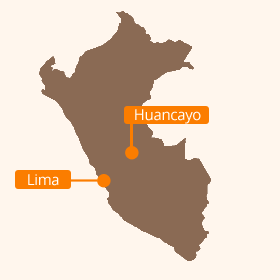

So for the rest of the day I read about Huancayo and went over my notes from the CIP DVD to get acquainted with the methods.


Friday

On Friday, there still was not much to do with the two projects I’m working on. So in the morning, I worked with Ximena on setting up a weather station for a new project. We collected the various pieces from the storage room (including a temperature sensor, a relative humidity sensor, an anemometer, etc.) and brought them upstairs for assembly.

Afterwards, I helped do some transplanting for another project.  The seed tubers were planted in shallow trays with sand substrate, so I had to separate the roots of each sprout, and pull the sprouts off the seed tubers and rinsed them.  


However, the guys running the experiment only wanted sprouts that were less than an inch and a half tall, we only ended up with nineteen plants out of 150 transplanted. 


Then I helped Luciano and David attach thin rods to the plants in aeroponics to give them support as they continue to grow.

Saturday

At about noon, I went with Liliam and Daniel to a party in a neighboring district.  From what I understood, a couple that was from Huancayo (where Liliam and Daniel are from as well) hosted a large mass and gathering to commemorate a local patron saint called Señor de la Agonía (which looked like a really morbid Jesus).  

There was a large mass, which I found even more difficult to understand as the priest spoke in both Spanish and Quechua (a native Peruvian language).  Afterwards, everyone danced to Wayna music in large circles.  


Then we were finally able to eat lunch at about 3pm, and I don’t think chicken has ever tasted so good!


Sunday

On Sunday, I decided to try one of the churches that Carmen had suggested. I thought I would make sure I could find the church and then return at noon when the next service started, but when I got there people were still straggling in so I decided to just go in.  I quickly found a spot towards the back, and as I was shuffling past people in the row I heard my name called – it was Carmen! After the service (which I understood most of, yay!) Carmen introduced me to her mother and her nieces, and I was invited back later that evening for the youth group service. 


After youth group, I went home and packed for my trip to Huancayo.  Overall, it was a nice end to my fourth week – halfway done with my adventures in Peru!

Friday, July 11, 2014

Part Two

Thursday

On Thursday morning, I went out to the greenhouse to check on the progress of the experiment.  I used a smart phone (Samsung, which is by far more popular than iPhones here) and recorded which pots had emerged.  Over 87% of the sprouts had emerged, but most of them are still tiny (yes, that is a scientific measurement J).

Afterwards, I took measurements for the aeroponics experiment.  For each plant, I measured the height in centimeters and then counted all of the mature leaves.  I also used a smart phone to input the information for easy access and analysis.


For the rest of the day, I didn’t have any other tasks, so I spent it working through various publications and readings. Also, Dr. Khan was leaving again for business travel and so he was kind enough to introduce me to CIP’s Chief Operating Officer, Michael Gerba, and I got an invitation to their 4th of July party!


Friday

I started the morning in the aeroponics greenhouse taking more measurements of the plants.  First I used a handheld SPAD meter, which uses a sensor to calculate the chlorophyll content of the leaf. I would select the top leaf of the third newest mature leaf set to analyze.  I clamped the leaf in the SPAD meter and took the average of about five measurements from the leaf’s tip to get the most accurate value.


Next, I used an instrument to measure the stem diameter of each plant.  I took the measurement from where the stem showed above the identification tag, and recorded the value in millimeters. Then I entered the data into the smartphone. 


Friday afternoon, Flavio, Jorge, and I weighed, mixed, measured, and applied fertilizer in the greenhouse experiment.  The fertilizer supplier brought some extended release fertilizer for us to use, so we weighed and mixed the different components to create our fertilizer mix.  

Then we tracked down a scale and I weighed out 17 grams of fertilizer and put it into baggies for Jorge to distribute into each of the 180 pots.


Then Jorge showed me how they form a circular moat around the potato sprout and pour the fertilizer in, cover with soil, and lightly compress it down.


After work, I discovered my new favorite supermarket on the walk home, TOTTUS.  I had walked by it multiple times before, but couldn’t tell what it was because the concrete façade had no indications of what was inside.  So I looked TOTTUS up online and discovered that it was a supermarket, and I decided to visit on Friday.  


At first, I was a bit confused because the store doesn’t begin when you enter the doors, it’s a long corridor of small shops.  But once inside, I found the most American-like supermarket I’ve been in so far, it was essentially a Hy-Vee, and I was thrilled.  It was also a bonus that the Coke was slightly cheaper and they had a better snack selection.  Even though I keep buying snacks, I justify it because the long walks to get there must burn off all those calories…right? J

At 6:30, Michael Gerba came and picked me up for the 4th of July party which was hosted by Dave Ellis (the head of CIP’s Genebank, who Dr. Khan had introduced me to at the Gathering Under the Tree).  The house was lovely and there was SO MUCH FOOD!! I think Dave Ellis was churning out steak, grilled veggies, chicken, and brats (we had Johnsonville brats, the perks of having a US Embassy official there!) and there was also chips and guacamole, snack mix, and so much more.

It was such an interesting group of people, with CIP employees, friends, and neighbors. About half of the people were Americans, but through their conversations I discovered that although they may have grown up in the USA they had lived in such an incredible array of countries.  It was such a melting pot of cultures and experiences, but in reality, what is more American than that?


Saturday


My weekend was very relaxing.  On Saturday, I had planned to go to a cultural dance festival in the district I live in, but was disappointed when Daniel decided to turn back because the traffic was bad.  When we returned, I went to the market with Liliam and she bought adorable baby clothes for her grandkids and some pretty flowers.

Thursday, July 10, 2014

The Past Week and a Half (Part 1 of 3)

Please bear with me while I desperately try and catch up on blogging, and stay tuned for the next installments!

Monday

On Monday I spent the whole day working with Ximena and Elisa on preparing, organizing, and taking samples of a large set of potato plants in the greenhouse.  The samples would then be sent to an analysis lab in CIP where they would be tested for Potato Virus X (PVX) and Potato Virus Y (PVY).

Ximena and I started by putting information labels on small, clear plastic sleeves that were used to hold the sampled leaves.  Each sleeve was placed in numerical order into pots of 90 sleeves.


After we finished labeling the sleeves, with over 500 samples for each virus, we began to take samples. We started with the plants that were supposed to be infected with PVY by grafting in an infected potato shoot into the stem.  To sample, we took three medium sized leaves from the top canopy of the stem that had been grafted. 

Matching the identification number

By the time we finished with the PVY samples, it was time for lunch, so we took a break before coming back to do the PVX samples.  The process was very similar, but the PVX was not transmitted by grafting, so I just sampled off of any stem.


When I got home from work, I surveyed my small stash of snacks from the last grocery store trip, and decided to try the Peruvian cookie thing called the Turron de Doña Pepa. It was a sticky layered cookie topped with sprinkles that, upon further research, I learned is eaten most often in the month of October and is an anise-flavored cookie stack that is soaked in a sugary molasses mixture. It tasted pretty good, and was incredibly sticky!


Tuesday

Tuesday morning, I started work in the Aeroponics greenhouse taking pictures of the roots.  We had to roll up the black plastic walls and then formulate a standardized procedure for taking the photos that will be used to analyze the length (using a scale in centimeters posted on each section), width, and approximate volume of the roots.


Afterwards, I had a short meeting with Dr. Khan to talk about the research and goals of his group (they target abiotic stress in potatoes, including drought, heat, and salinity stress) as well as of this experiment.  Overall it went fairly well, and I enjoyed getting a nice overview of the work.

That afternoon, I worked with Flavio and Jorge to put three irrometers in three different pots in the greenhouse experiment.  The irrometers record the percentage of water in the soil, and we will use them to judge whether or not the application of water is sufficient in later stages of the project. 


We had prepared the irrometers by soaking the ceramic tips in distilled water for several days, and we had to then fill the inner chamber with a special solution and use a suction pump to extract any air bubbles that would interfere with a good measurement. 


Jorge filling an irrometer
That afternoon, there was the World Cup USA versus Belgium game.  I missed most of the game because I was working, but once I got home I sat down with Daniel and Liliam to watch the overtime.  I even splurged and had my microwave popcorn and Coke to celebrate the game.  However that celebration soon turned into disappointment as the USA lost and I drowned my sorrows in popcorn and Coke.


Wednesday

I spent all day on Wednesday helping prepare seed potatoes for a field trial in Arequipa (a southern region in Peru where CIP has a field station). Jorge, David, and I would select seed potatoes with the best sprouts and put ten per bag with six bags per genotype and fifty-two genotypes, for a grand total of over 3,000 spuds.


We went to the diffused light storage where I had picked out seed potatoes for the greenhouse project a couple weeks prior.  David located and organized all of the crates of potatoes in numerical order, and I sat on an upside down crate and selected potatoes.


After we had selected all the potatoes, we lined up the bags in numerical order and then David would call out the number of the genotype (from 1 to 52) and Jorge and I would locate and pack them in large cardboard moving boxes. Jorge joked that it was like calling out Bingo numbers, but we never won anything J


When I got home, I tried the Copa de los Sabores chips for Brazil, because it was the only other flavor the store carried.  They were supposed to be like a steak flavor, that tasted more like strange roast beef.  I’m still not really sure what I think of roast beef flavored chips…